Tuesday, 1 September 2026

Episode 31 (Season 3, Episode 4) - Jessica Bodily

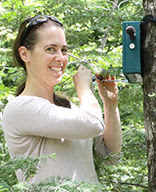
Jess received her Bachelors in Psychology with Honors in 2007 from the University of Kentucky. She subsequently earned her MS (2010) and Ph.D. (2013) in Experimental Psychology, both completed in Thomas Zentall’s laboratory at the University of Kentucky. She was a Lecturer of Psychology at the University of Florida from 2013-2017, and at Georgia Southern University from 2017-2020. Currently, she is an Associate Professor in the department of psychology at Auburn University at Montgomery. 

Her research is in the Cognitive-Behavioral area and centers mainly on decision-making processes and suboptimal choice behavior across species. Her work explores the various conditions under which certain choices occur as well as how aspects, such as personality traits and past reinforcement history, play a role in choice behavior. One of her favorite things about being a faculty member is having the opportunity to introduce students to research and to help them navigate their career path. In addition to mentoring undergraduate researchers in her laboratory, she teaches classes in behavior analysis, cognition, and psychological careers. In 2025, she won the Auburn University at Montgomery’s Distinguished Teaching Associate Professor Award. Jess was a program committee chair for the American Psychological Association Division 6 meeting in 2026 and is currently the President of the Comparative Cognition Society. Away from work, Jess is a mother of three who loves coffee, nature, and watching college basketball and football (War Eagle and Go Cats!).

mp3 download

Wednesday, 26 August 2026

Episode 30 (Season 3, Episode 3) - Dave Stahlman

Wait, I think this might be the first Dave on the podcast other than, well, you know....

Dave got his B.A. in Neuroscience from Franklin & Marshall College in 2004, where he worked with rats, capuchins, and macaque monkeys. He then completed an M.A. (2006) and Ph.D. (2010) at the University of California, Los Angeles, where he studied in Aaron Blaisdell’s Comparative Cognition Lab examining the control of behavioral variability. After receiving his Ph.D. he spent three years teaching and doing research at UCLA, working with rats, pigeons, and hermit crabs. In 2012, he received a tenure-track appointment at the University of Mary Washington in Fredericksburg, VA, where he is now a Professor of Psychological Science. 

He teaches courses in learning, neuroscience, and research methods, and runs his department’s animal research laboratory with its invertebrate and rat vivaria. He is interested in and has published work on basic behavioral processes. He has also published work on theoretical and philosophical matters, specifically as regards Skinnerian radical behaviorism, to which he was a convert after leaving UCLA. He’d like to think he’s known around his department as a friendly killjoy.

Off-campus, he enjoys Chicago Cubs baseball, going to the movies, and homebrewing odd and time-intensive beers. 

mp3 download

Tuesday, 25 August 2026

Episode 29 (Season 3, Episode 2) - Tanya Shoot

Tanya's research is at the intersection of behavioural ecology, evolution, and animal and plant cognition. The main questions they ask revolves around why and how organisms make the decisions they do and how personality, experiences, and environment impact these decisions. This research is both multi-taxa and multi-methods, spanning empirical investigations of nest-building flexibility in zebra finches during their Undergraduate and Masters at Western University, group decision-making in zebrafish and guppies with manipulated personality compositions, and theoretical modelling of the impact of personality in fruit fly populations for their PhD at Wilfrid Laurier University. 

Most recently, Tanya has had the opportunity to construct a theoretical framework of what studying plant information processing should look like as a postdoc at the University of Alberta, along with designing empirical experiments to test the framework.  Tanya plans to continue this line of research in their relatively new position at CUE and is excited to see how the different branches of plant behaviour compare to what we know about animal behaviour. 

We talked about a lot of stuff, we made fun of Noam a bit, ok, maybe that was just me, and we of course did a deep dive on Tanya's plant cognition work.

mp3 download

Thursday, 23 July 2026

Episode 28 (Season 3, Episode 1) - Madeleine Brodbeck

Look, I've been waiting to do this one for quite a while.

Hell, I'm pretty sure I applied for this sabbatical so I could interview Madeleine.

A bit about Maddie:

Madeleine Brodbeck completed her BSc in psychology at Algoma University in Sault Ste Marie, ON in 2015 (I was there for a lot of it, well all of it really I suppose).  

Maddie then moved on to the University of Western Ontario and the Advanced Facility for Avian Research (AFAR).  At AFAR she worked under the supervision of Scott MacDoguall-Shackelton and David Sherry.  

Her PhD work focussed on brain regions associated with electromagnetic field perception in songbirds.  Her MSc work was on memory in brown headed cowbirds (which she is revisiting, stay tuned).

She currently works as a research assistant and lab manager for the quantitative linguistics group at the University of Tübingen in Germany.

In her non science time she loves travelling, cooking (food in general really) and video games.

We talked about science, and some not science, as well as stuff and things.  (I quite clearly do these writeups before the interview, in fact, most of it is written by the guest).

mp3 download

Wednesday, 1 December 2021

Episode 27 - (Season 2, Episode 8) - Marisa Hoeschele

Scientist and metal drummer 
Marisa Hoeschele received an honours B.A. in Psychology with a minor in Philosophy at the University of Guelph, Canada in 2006. After that she completed an M.Sc. and PhD in Psychology with a specialization in Comparative Cognition and Behaviour at the University of Alberta, Canada.

In 2013 she moved to Vienna as a post-doc and built the budgie lab at the Department of Cognitive Biology at the University of Vienna. In October 2018 she started her own group, known as the “Musicality and Bioacoustics” group, at the Acoustics Research Institute of the Austrian Academy of Sciences. This institute has researchers from many different disciplines all studying problems in acoustics: however the first animal studies were not conducted on site until this year in April when the budgie lab was moved to the institute. Marisa studies how different animals, including humans, perceive and produce sounds. The broader goal is to understand where music and language come from and what other similar capacities might exist in the animal kingdom.

Marisa is the first guest I've had on who had a pop filter on her mic.  That's neither here nor there but it's still a thing.

We talked, of course, about how Marisa got into the field in the first place, a bit about Austria and, obviously about her work.  Her work is interdisciplinary and we talked a bit about how this sort of thing is important not just in animal cognition, but in any field.


Thursday, 28 October 2021

Episode 26 (Season 2, Episode 7) - Jennifer Foote

Woo hoo! This one should be fun. Partly because I'm talking to.a friend and colleague from Algoma University. Also because it will be only the second episode I've done face to face. Jenn Foote came by my podcast studio (OK, look, I have two podcasting studios in my house, because I'm me, so to be clear, she came to Studio B). and we talked about her work, her origin story, and other stuff.

Jenn Foote completed a BSc. Honours in Biology from St. Mary's University, where her thesis research investigated how neighbour-stranger discrimination in song sparrows was influenced by breeding stage of females. She then moved up the road and completed MSc. in Biology at Dalhousie University where she demonstrated that Eastern song sparrows in NS share songs like west coast birds and unlike other eastern song sparrows. Both her BSc. and MSc. work was supervised by Colleen Barber. Jenn completed a PhD at Queen's with Laurene Ratcliffe where she studied dawn chorus communication networks of black-capped chickadees and demonstrated that males interact vocally at dawn and those interactions sometimes included three or more males. She then did a short postdoc with Dan Mennill at University of Windsor before moving to Algoma University in 2010. She then moved to Algoma University where her lab, the OVEN (Ornithology, Vocalization, and Ecology Network) has been studying vocal behaviour of northern Ontario songbirds. The OVEN does in fact study ovenbirds.

mp3 download

Tuesday, 7 September 2021

Episode 25 (Season 2, Episode 6) - Fiona Cross


OK, look, I won't lie, I do love talking to all of the people who have come on the podcast. But, there is one person I've been hoping to talk to since way back in Season 1. It's FIONA CROSS!

Fiona got her BSc (Hons) in Psychology in 2001 before she began working with spiders and then she got her MSc (with Distinction) in Zoology in 2003 and her PhD in Zoology in 2009, with all three degrees being at the University of Canterbury in Christchurch, New Zealand. Dr. Cross first went to Kenya to work with spiders in 2006, and has been a Visiting Scientist at the International Centre of Insect Physiology and Ecology (in Kenya) since 2010. Her research interests include selective attention, working memory, expectancy violation, and problem solving by spiders. Fiona never used to think that spiders could be particularly interesting, but she has since learned that spiders can do many remarkable things that could keep a person awake at night.

Dr. Cross has 46 publications, and her work has featured in many news sources including The New York Times, The Washington Post, National Geographic, BBC, The Guardian, The New Zealand Herald, and Radio New Zealand. Fiona is sorta famous really, to quote her 'I got a fright when I first discovered there is a Wikipedia page about me, and I had to sit down when I discovered that a video about me had been viewed 12,000 times in one day'.  (BTW, that fame is well deserved, she rocks).  As an aside, there used to e a wikipedia page about me, but it was deleted because I suck....

She loves to communicate science, and has so far organized three of her own international speaking tours (one in the UK and two in North America). COVID permitting, she hopes to run a spider event for children at the Christchurch public library in October (the month of the year that arachnologists affectionately refer to as ‘Arachtober’). She's also keen on writing for all ages.

You can learn more about her and her work at her website (www.doctorspider.net).